
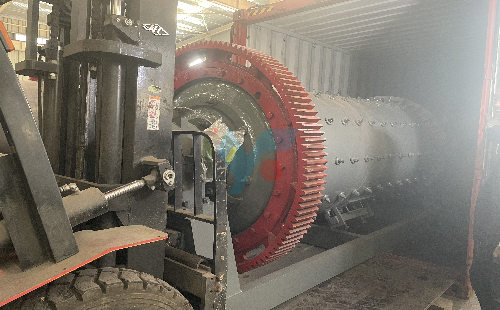
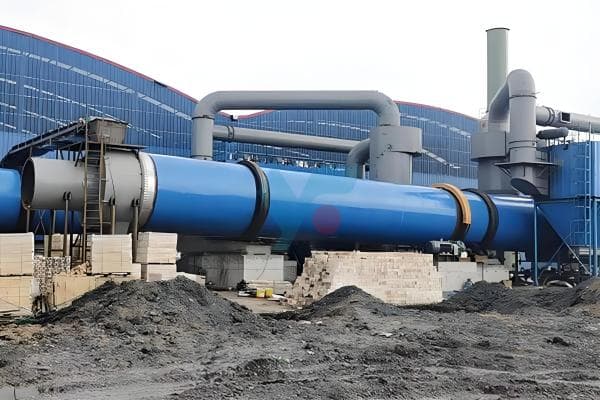
Slag Rotary Dryer
Description:
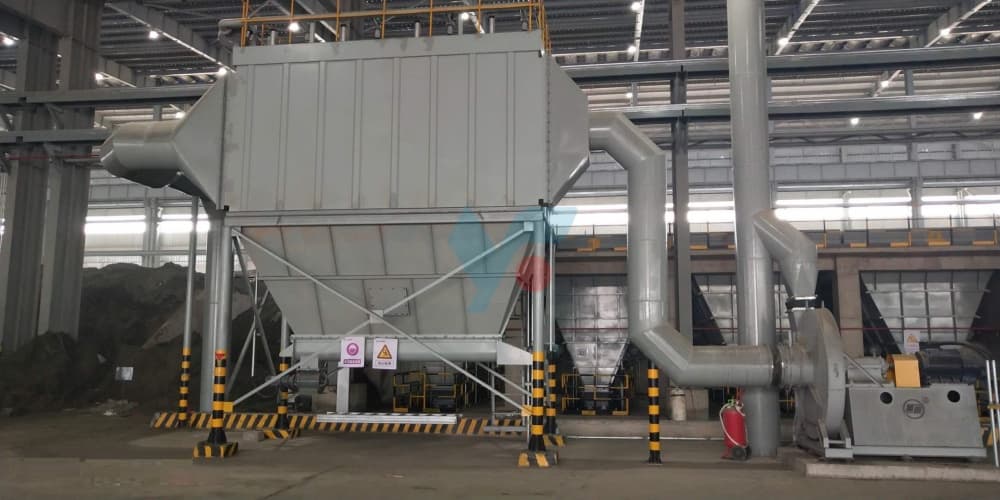
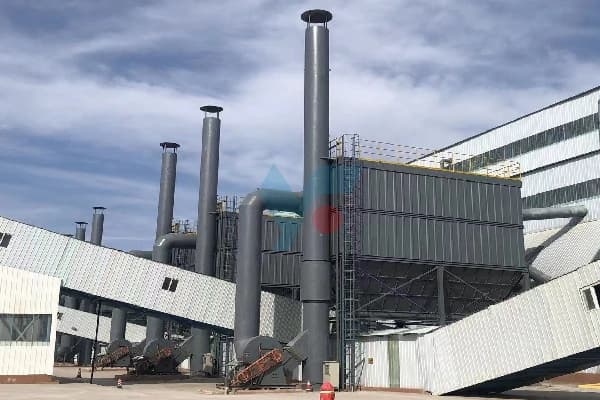
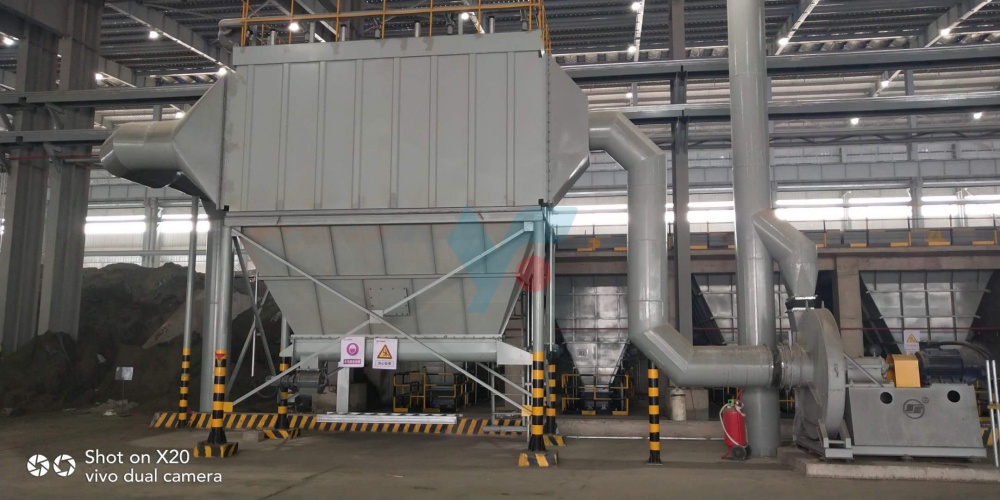
The YQM series pulse-jet bag filter combines the advantages of split-chamber reverse-air cleaning and pulse-jet injection, overcoming the insufficient dust-cleaning kinetic energy of split-chamber reverse-air cleaning and the drawback of simultaneous cleaning and filtration of pulse-jet injection, and broadens the application range of the bag filter. This filter effectively improves the dust-removal efficiency and operating reliability of the air-box pulse bag dust collector and extends the service life of the dust collector. It is widely used for dust removal and purification of industrial powders in various industrial and mining enterprises such as metallurgy, building-materials production, machinery, the chemical industry and mining.
Field of application: widely used for dust removal and purification of industrial dust in various industrial and mining enterprises: metallurgy, building materials, machinery, chemical industry, mining, etc.
Applicable materials: cement, calcium-based powder, silica micro-powder, titanium dioxide, silicon-dioxide powder, iron ore, limestone, quartz, construction waste, iron ore, gold ore, etc.
Advantages:
- Adapted to removing high-concentration dust. In the O-Sepa powder concentrator the gas-dust concentration in its powder system reaches 1000 g/Nm³; the JQM-type air-box pulse bag filter can process it directly, with no need to install first-stage dust-removal equipment such as cyclone dust collection.
- Off-line dust-removal technology is used to perform pulse dust removal with reverse blowing of the sub-chamber, which not only avoids the secondary adsorption of dust caused by on-line dust removal, but also does not affect the normal continuous operation of the equipment under operating conditions, improves the dust-removal effect and extends the service life of the filter bag.
- Application of the patented "self-locking sealing device of the filter bag" technology, which improves the tightness between the tube sheet and the filter bag and increases the dust-removal efficiency.
- The equipment uses an air-box structure, which reduces the local resistance of the equipment and eliminates the inconvenience of installing filter bags.
- The double-diaphragm electromagnetic pulse valve offers advantages such as sensitive control, high efficiency and long service life.
- An automatic cold-air valve is installed. When the temperature of the intake air reaches the set equipment temperature, the cold-air valve automatically opens the cold air to lower the internal temperature of the equipment body and ensure that the filter bag is not burned by high-temperature gas. When the internal temperature of the equipment box drops to the set equipment temperature, the cold-air valve automatically closes, ensuring normal operation of the equipment.
Structure:
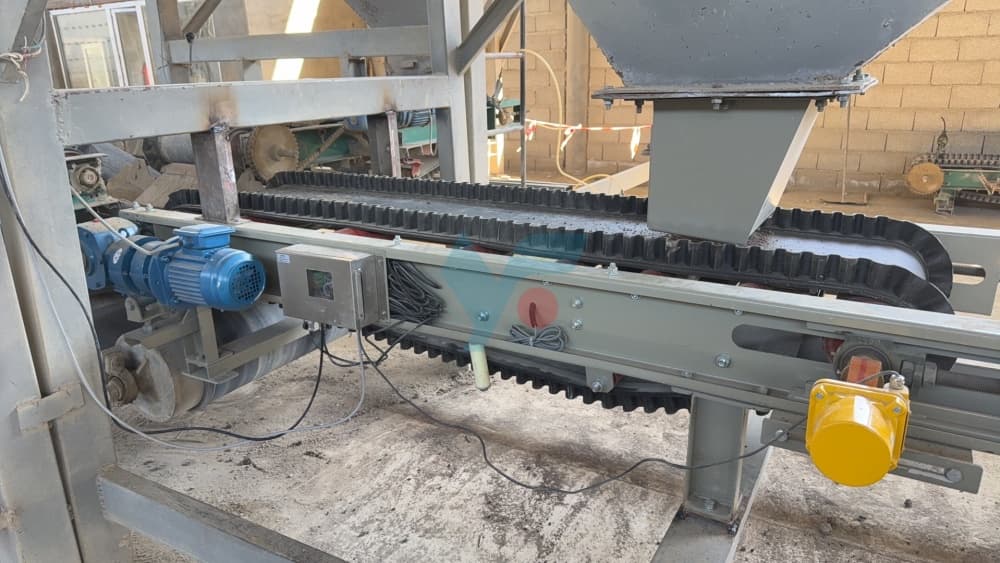
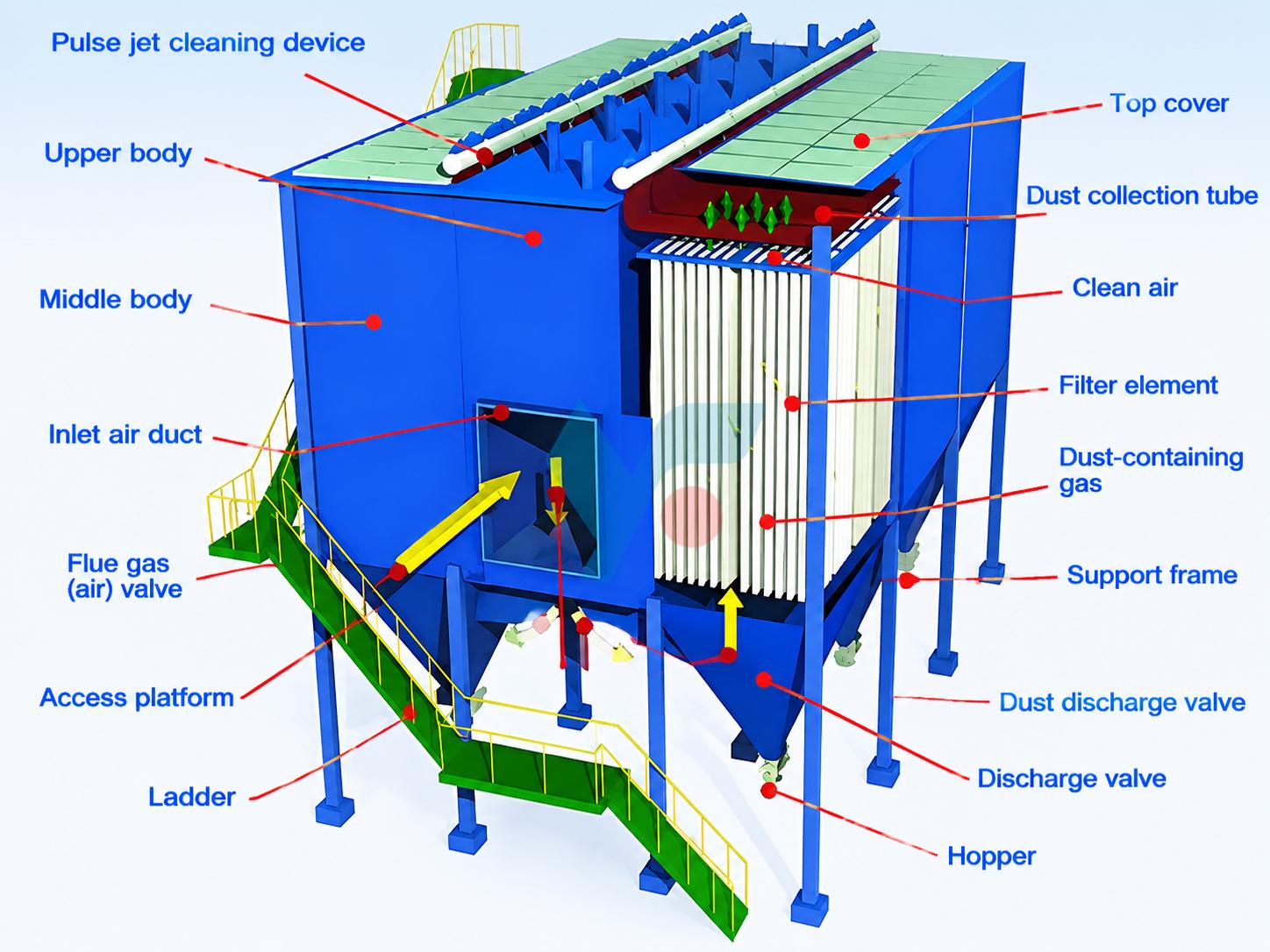
The YQM-type air-box pulse bag filter mainly consists of a lower steel structure, an ash hopper, a middle box, an upper box, air inlet and outlet, the filter bag, the cage frame, an ash-removal device, an automatic cold-air valve, electrical and pneumatic control, etc. In addition, depending on the actual situation, the outer wall of the ash hopper can be equipped with a silo-wall vibrator, and the outlet of the ash hopper can be equipped with a star valve for ash discharge or a screw conveyor and other ash-discharge devices.
Working principle:
4.1 Filtration principle
Dust-containing gas enters through the air inlet. When passing through the ash hopper, some coarse dust particles in the gas are separated under the action of inertia and gravity and fall directly to the bottom of the ash hopper. After passing through the ash hopper, the dust-containing gas enters the bag-filter filtration zone of the middle box. The gas passes through the filter bag, and dust is trapped on the outer surface of the bag filter. After purification, the gas enters the upper box through the neck of the filter bag and passes through the air outlet.
4.2 Dust-removal principle
As the filtration time increases, the dust layer on the filter bag keeps thickening, and the resistance of the dust-removal equipment keeps rising. When the equipment resistance rises to the set value, the dust-removal device starts cleaning the dust. First, the lifting valve of the auxiliary chamber is closed to cut off the filtered air flow, and then the electromagnetic pulse valve opens. Compressed air rapidly expands in the upper box in a very short time and enters the filter bag, causing the filter bag to expand and deform, causing vibration. Under the action of cleaning, the dust adhering to the outer surface of the filter bag peels off and falls into the ash hopper. After dust removal is completed, the electromagnetic pulse valve closes, the poppet valve opens, and the chamber returns to the filtration state. The chambers are cleaned in sequence: from the start of cleaning of the first chamber to the start of the cleaning cycle, the chambers are cleaned in turn, cleaning is performed in the last chamber and then in the first chamber, and the cycle repeats.
4.3 Dust collection
The dust trapped after filtration and cleaning falls into the ash hopper, and is then discharged from the neck of the ash hopper through the hinged discharge valve and discharged through the automatic rotary discharge valve. It is transferred by the discharge belt conveyor.