
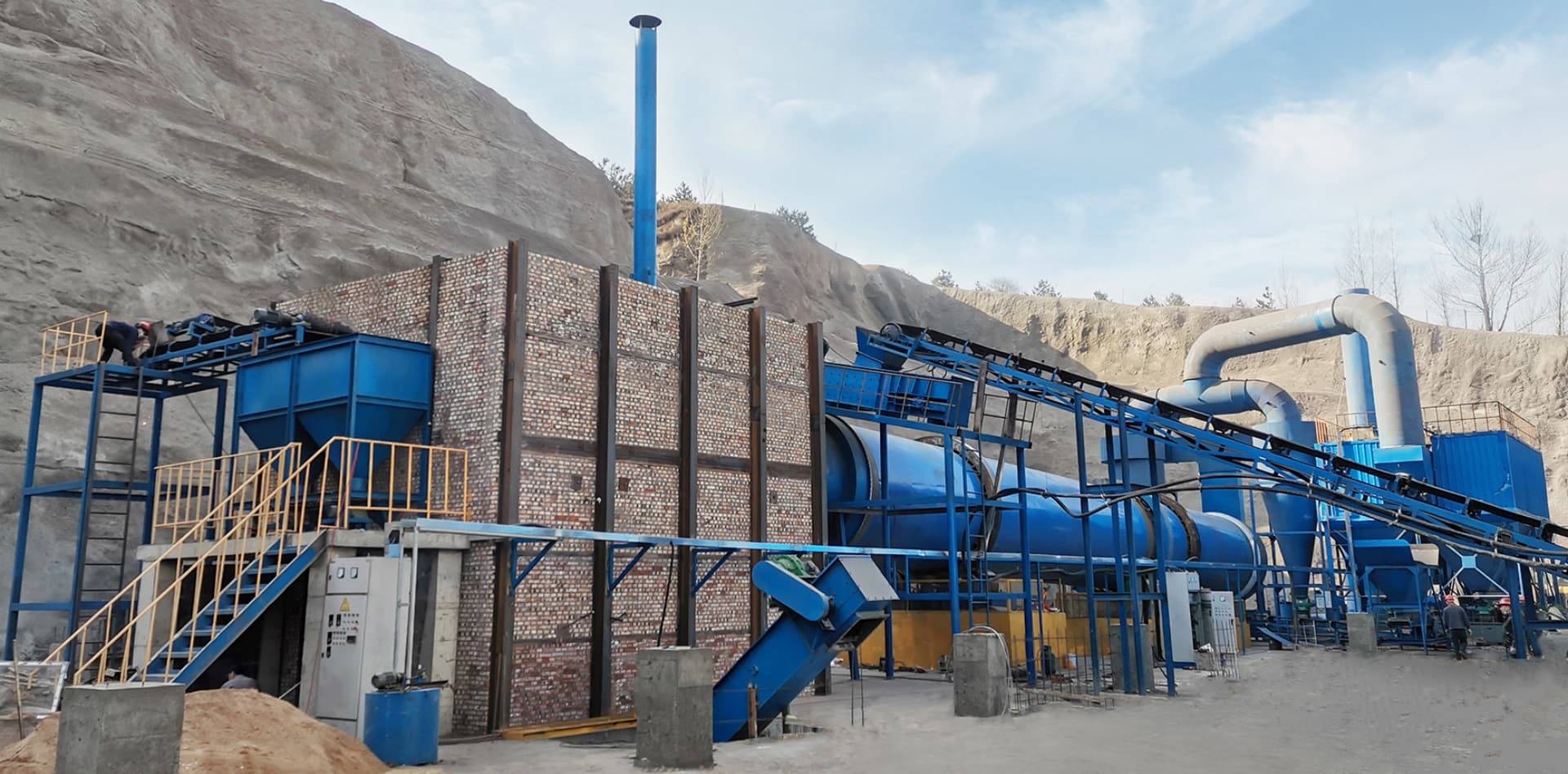
Mineral Powder Drying and Classification Line
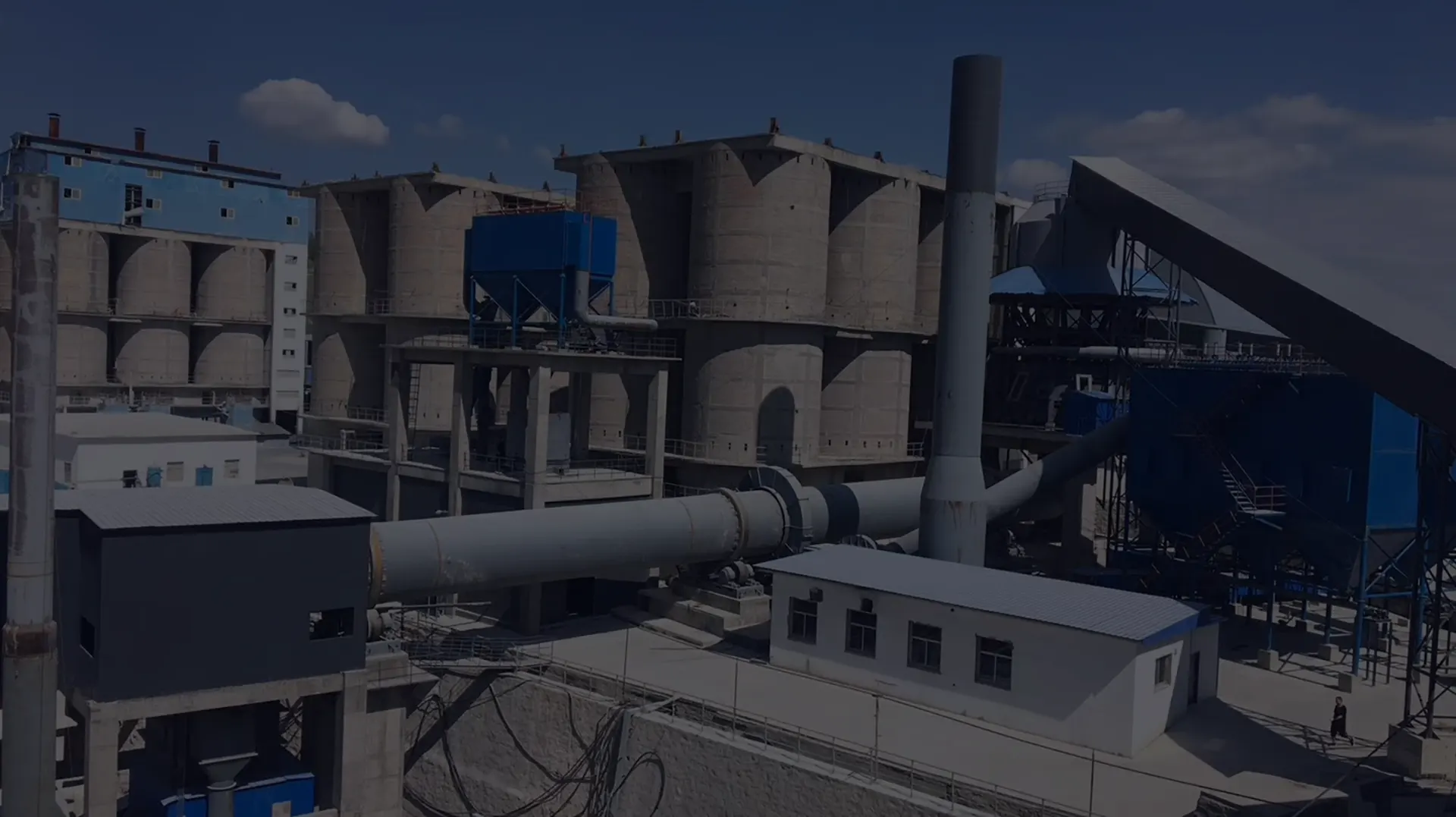
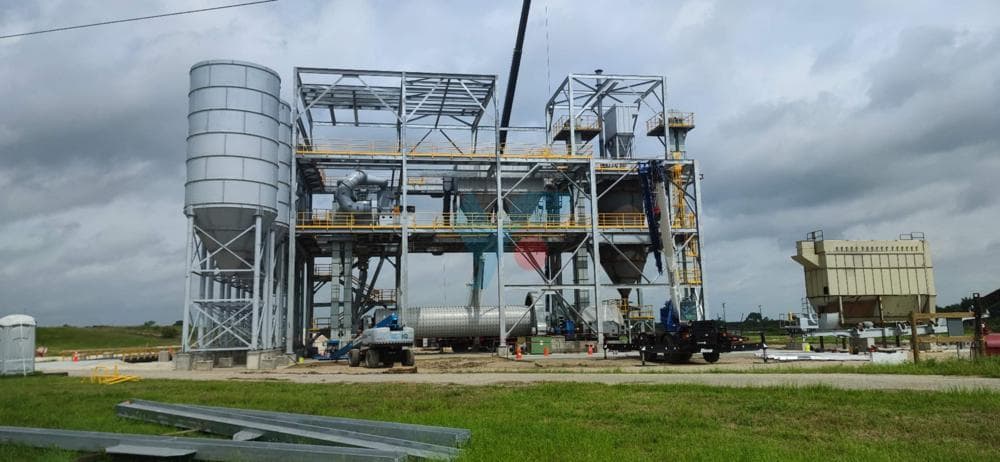
The cement grinding and classification line is designed for fine grinding of clinker with subsequent classification of the finished product, ensuring stable cement quality and high production efficiency.
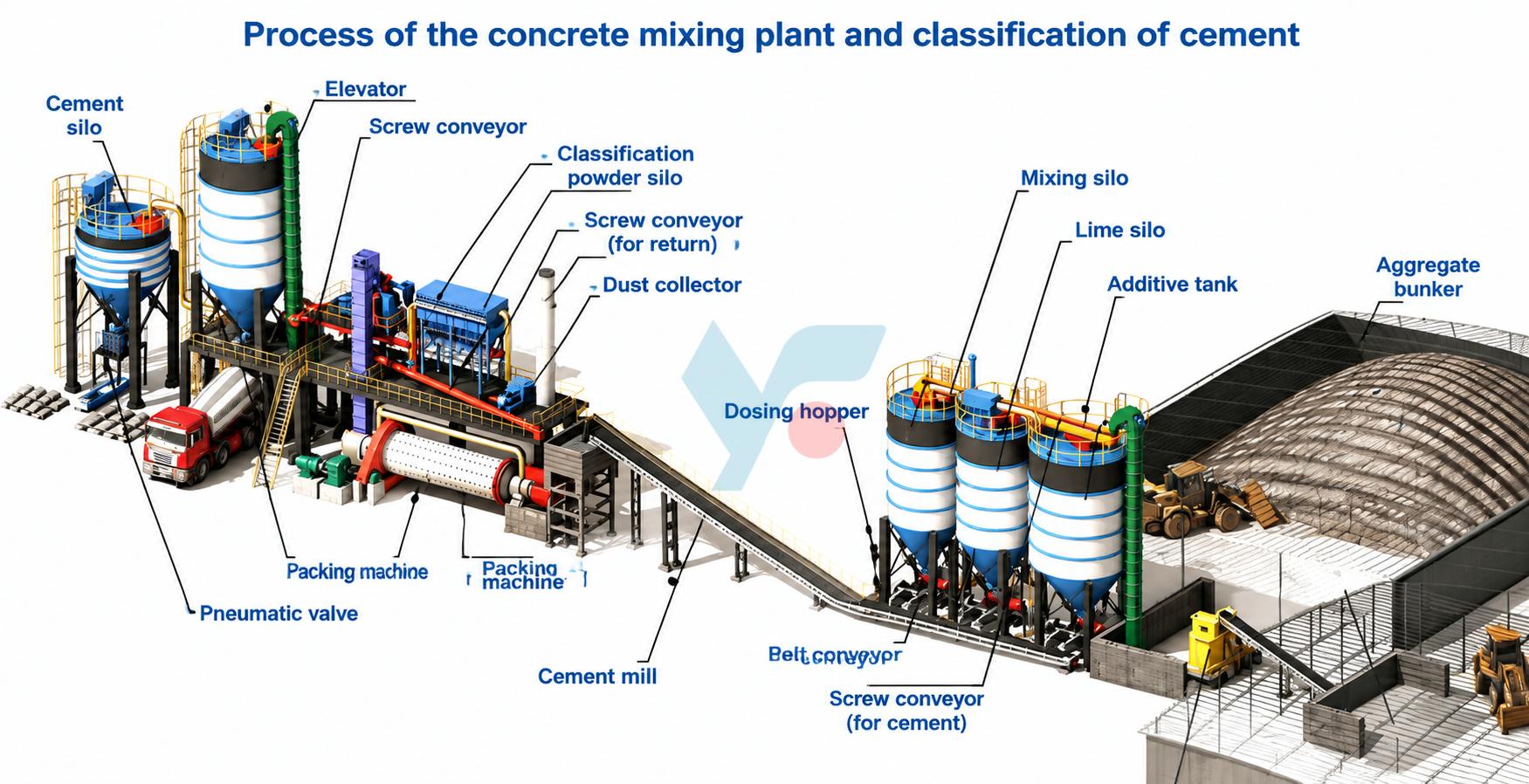
Main process flow:
- Raw material feeding. Clinker, gypsum and additives are fed through metering equipment, ensuring precise proportioning of the components.
- Grinding. The material enters the ball mill, where it is ground to the required fineness.
- Classification (separation). The ground material is directed into a high-efficiency classifier (separator): the fine fraction (finished product) is discharged into the storage system, while the coarse fraction is returned for regrinding.
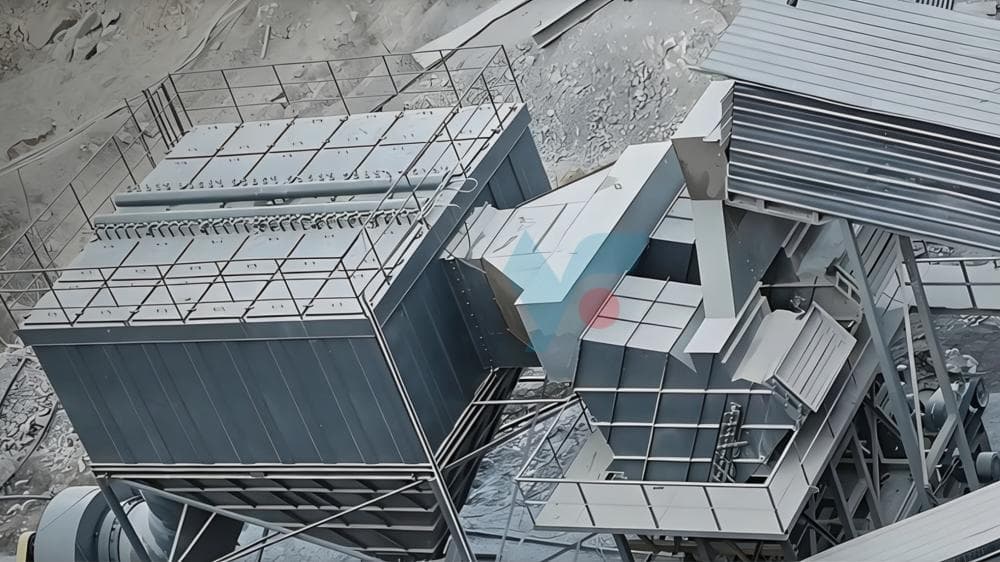
- Dust collection. The system is equipped with high-efficiency bag filters that ensure compliance with environmental standards.
- Storage and transport. The finished cement is conveyed to silos for storage or shipment.
Advantages of the line:
- Energy saving and high efficiency
- Stable particle-size composition of the product
- Flexible adjustment of grinding fineness
- Reliable and continuous operation of the system
- Compliance with modern environmental requirements
The cement grinding and classification line includes:
- Receiving silos (hoppers) for raw materials
- Belt weigh feeder
- Belt conveyor
- Drum ball mill
- Air classifier (separator)
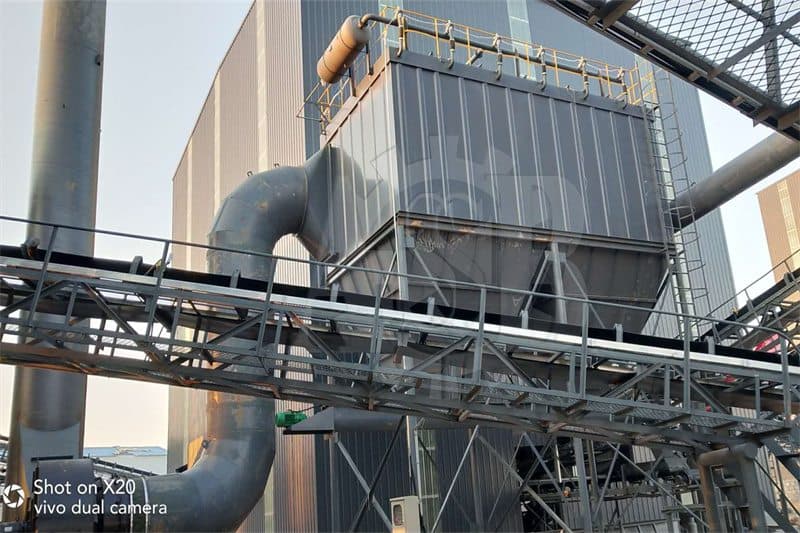
- Pulse-jet bag filter
- Bucket elevator
- Cement silos (hoppers)
- Packing machine
Receiving silos for raw materials
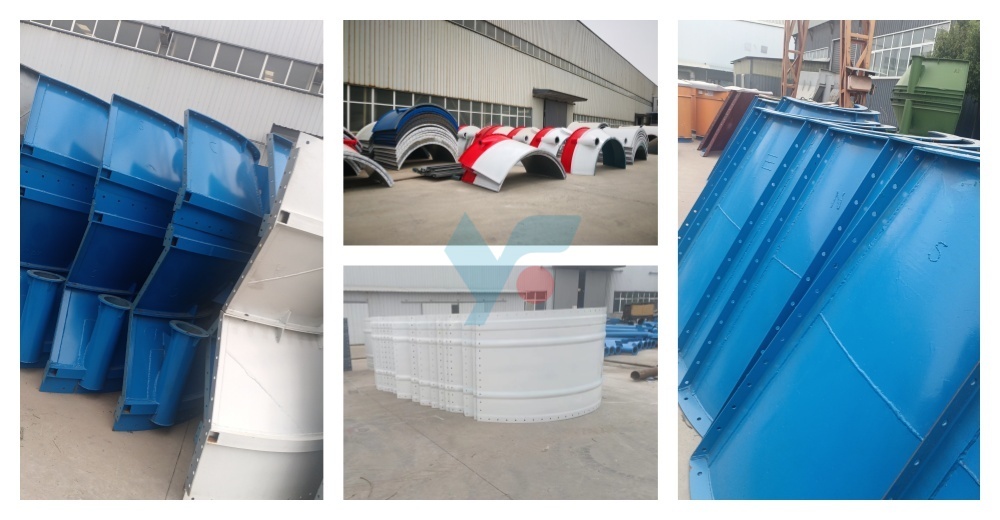
The receiving silos (hoppers) are used for receiving and storing raw clinker, gypsum and additives. The volume can be configured according to the user's needs, for example 50 t, 100 t or 200 t. The hopper (silo) has a sectional (modular) design, which ensures ease of transport and installation as well as high strength and durability.
Belt weigh feeder
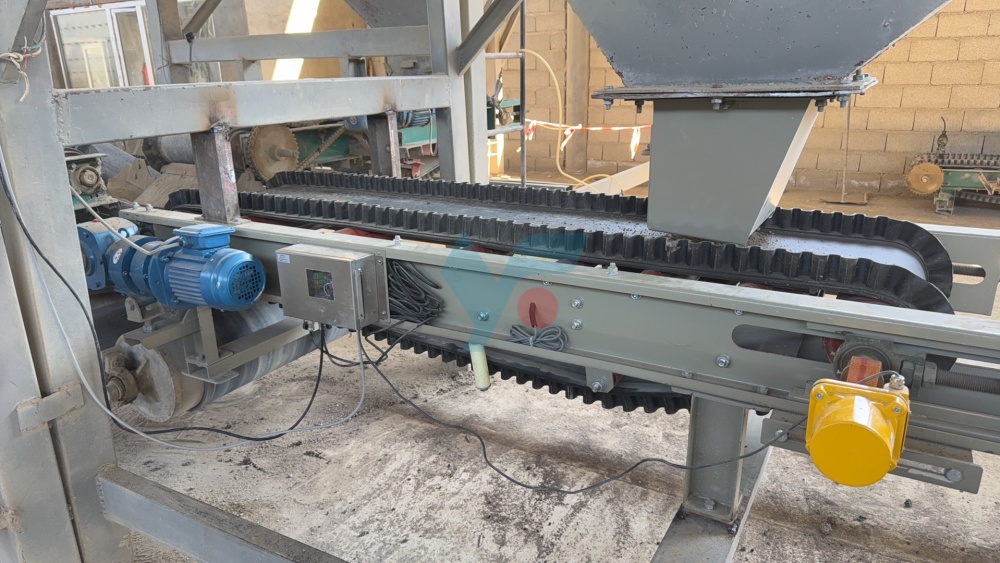
The belt weigh feeder is equipment that combines the functions of conveying, weighing and precise dosing. It is used for continuous and adjustable feeding of bulk materials.
Operating principle of the feeder:
- Mass measurement: load cells register the load on the belt.
- Speed measurement: a speed sensor determines the belt travel speed.
- Throughput calculation: the system computes the instantaneous flow rate in t/h.
- Automatic adjustment: a frequency converter changes the belt speed, ensuring the set throughput.
Main components of the feeder:
- Hopper (loading system)
- Belt conveyor with adjustable speed
- Weighing frame and load cells
- Speed sensor
- Variable-frequency drive (VFD)
- Control system (PLC / controller)
- Gate or feed regulating device
| Parameter | Value |
| Throughput | 0.5 ~ 800 t/h |
| Measurement accuracy | ±0.5% ~ ±1% |
| Dosing accuracy | ±1% |
| Belt width | 500 ~ 1400 mm |
| Belt speed | 0.05 ~ 1.5 m/s (adjustable) |
| Regulation method | Frequency drive |
| Power supply | 380 V / 50 Hz |
| Output signals | 4–20 mA / Modbus / Profibus |
| Operating temperature | -20℃ ~ +60℃ |
| Weighing type | 1 / 2 / multi-roller |
Drum ball mill
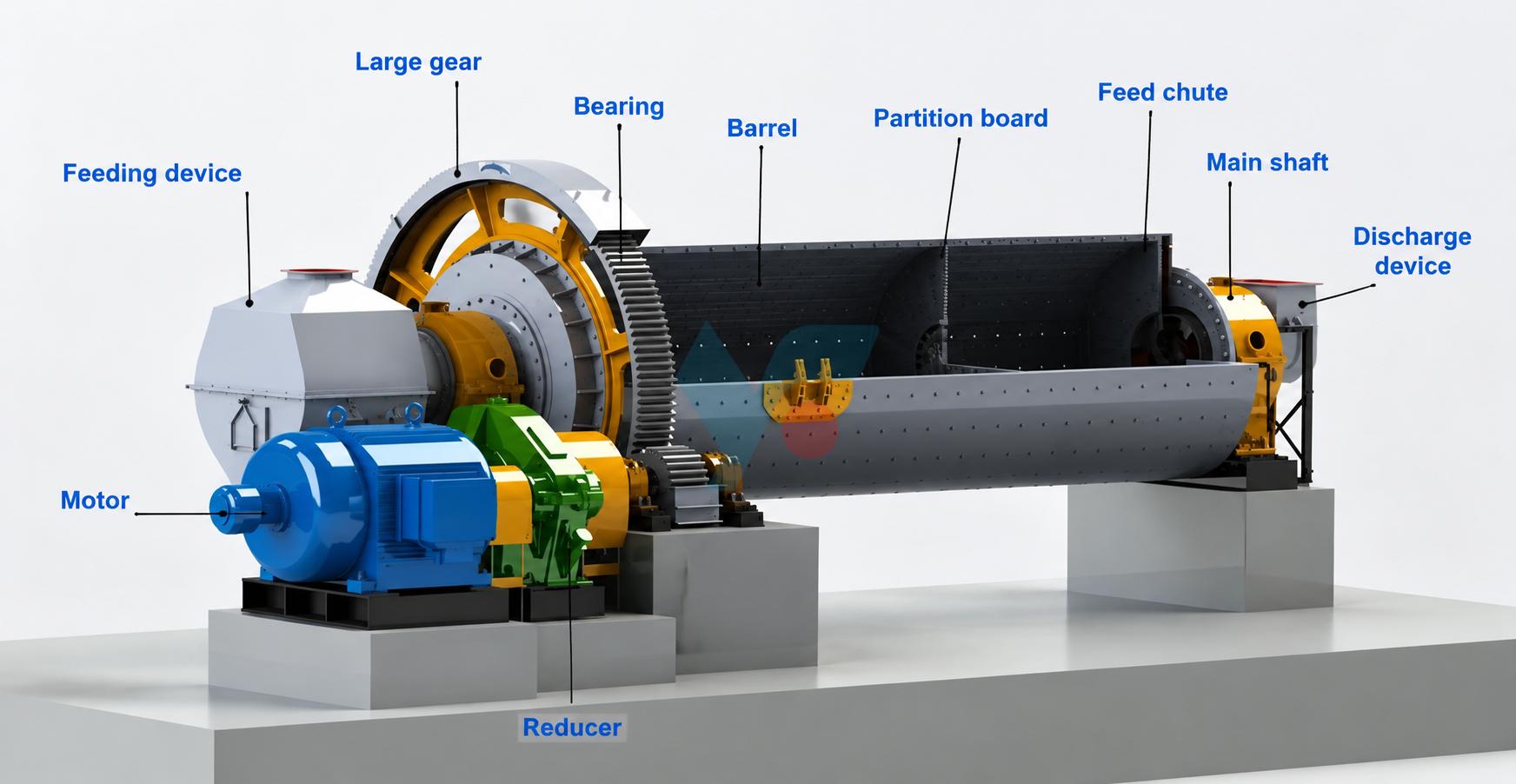
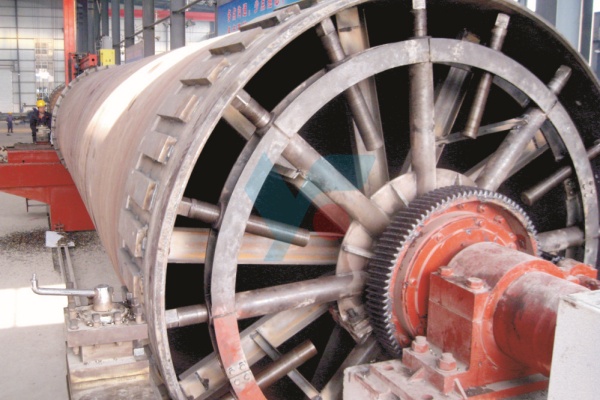
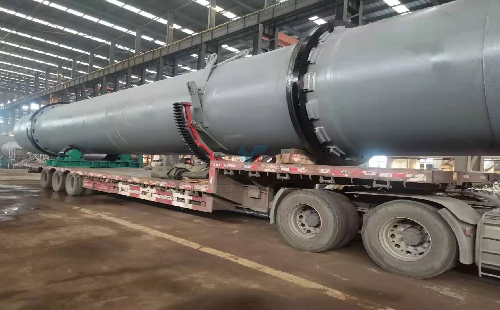
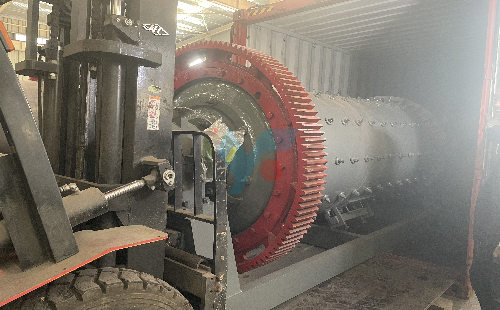
The drum ball mill is important equipment for crushing mineral raw materials and cement clinker, widely used in the mining industry, building materials, fertilizers, ceramics, the chemical and other industries. It uses grinding media such as steel or cast-iron balls to interact with the material through friction and impact, allowing it to be ground into powder.
Operating principle of the mill: the mill consists of a drum, feeding and discharge devices, a drive system and a transmission. The material is loaded through the feeding device into the drum, where it interacts with the balls, leading to their collisions and friction as well as to grinding of the material to the required degree.
| Technical parameter | Range of values |
| Feed material size | 0~25 mm |
| Output material size | 0.074 mm ~ 0.4 mm |
| Rotation speed | 18 rpm ~ 25 rpm |
| Throughput capacity | 1 t/h ~ 300 t/h |
| Grinding media | Steel balls, cast-iron balls |
| Drive power | 15 kW ~ 5000 kW |
| Mill dimensions | Φ900×1800 mm ~ Φ5000×8000 mm |
| Motor type | High-efficiency energy-saving electric motor |
| Voltage | 380 V / 50 Hz (can be customized to order) |
Applications of the ball mill:
- grinding of metallic ores: copper, iron, gold, zinc ores and others;
- grinding of non-metallic ores: limestone, gypsum, bauxite, limestone and others;
- production of building materials: raw material for cement, ceramics, glass and other materials;
- the chemical industry, for example the production of fertilizers and other chemicals.
Air classifier (separator)
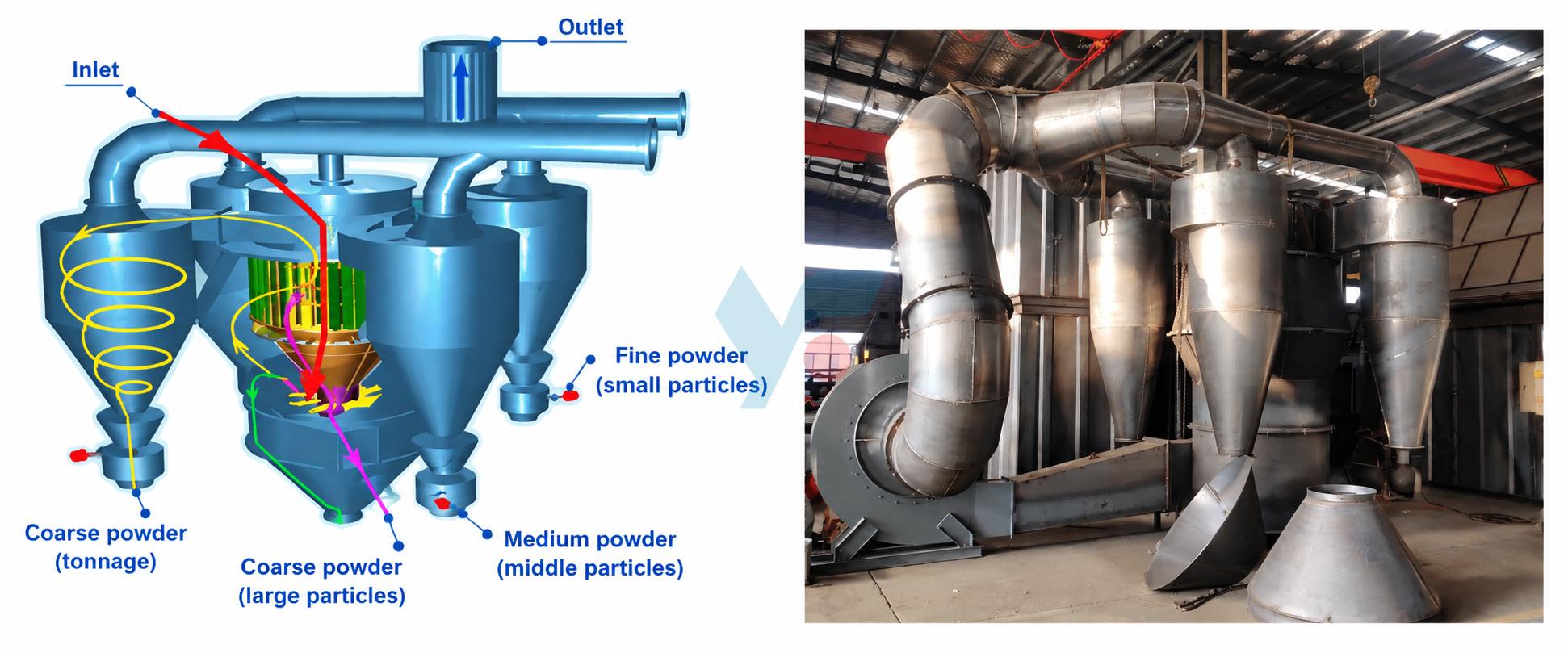
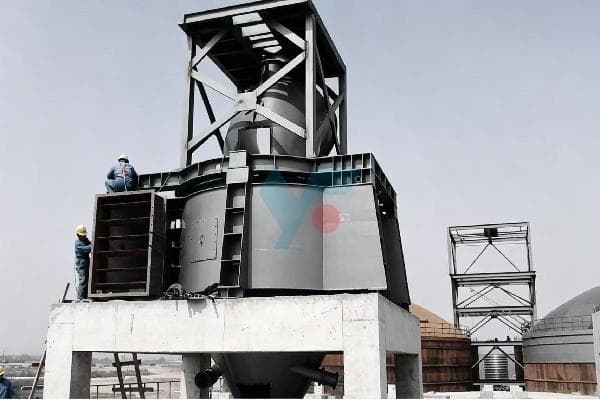
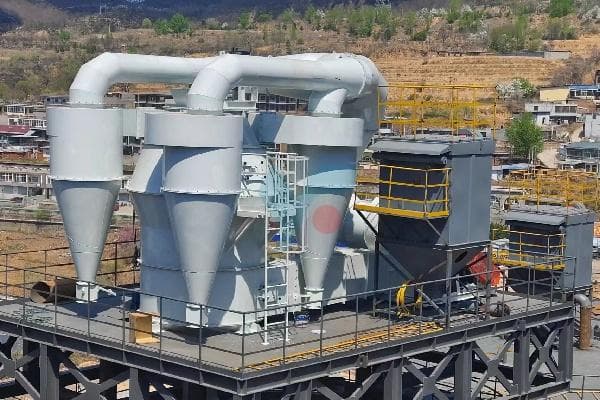
The air classifier uses air flows to separate materials by size, density and other physical characteristics. It effectively separates fine particles from coarse ones, provides product of the required dispersion, and allows precise control of particle size by adjusting the air flow and the speed of the working elements.
Operating principle of the classifier: the material is fed into the machine, where it interacts with a rotating impeller and the air flow. Fine particles rise and are carried into the discharge channel, while coarse ones remain in the working zone and return to the separation chamber for repeated processing.
| Technical parameter | Range of values |
| Feed material size | ≤ 10 mm |
| Output material size | 20 µm ~ 200 µm |
| Throughput capacity | 1 t/h ~ 100 t/h |
| Air flow speed | 10 m/s ~ 30 m/s |
| Impeller speed | 1000 rpm ~ 3500 rpm |
| Fan power | 15 kW ~ 200 kW |
| Fan capacity | 1000 m³/h ~ 80000 m³/h |
| Motor power | 5.5 kW ~ 160 kW |
| Suitable materials | Fly ash, mineral powder, gypsum, talc, etc. |
| Equipment weight | 1000 kg ~ 5000 kg |
| Overall dimensions | Customized |
Features and advantages of the classifier:
- high separation efficiency and precise process control;
- energy saving with high throughput;
- compact dimensions compared with traditional sieves;
- simple operation with an intelligent control system;
- low operating costs and long service life;
- wide field of application for fine and ultrafine powders.
Applications of the classifier: the mining industry, the construction industry, the chemical industry, metallurgy and environmental waste processing.
Pulse-jet bag filter
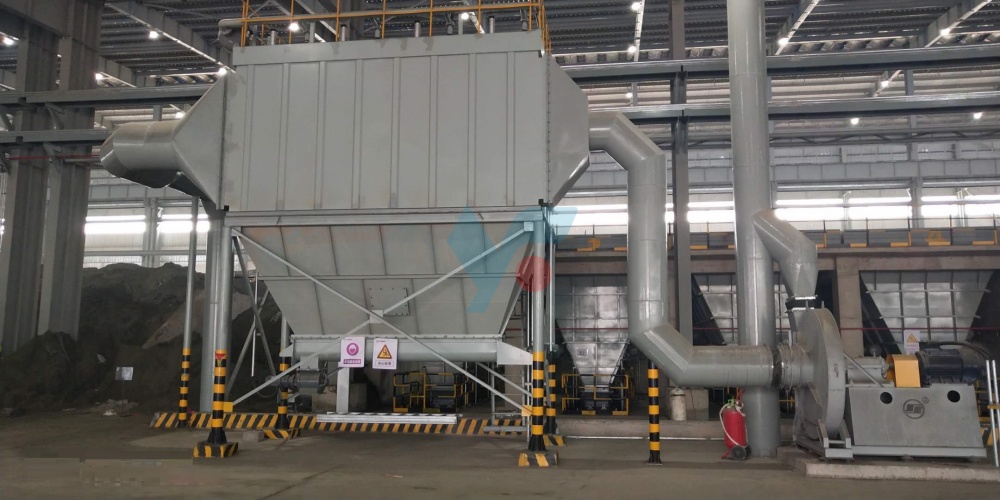
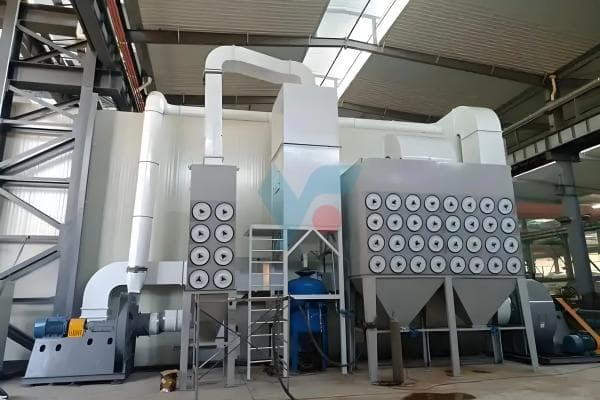
The pulse-jet bag filter is high-efficiency dry dust-collection equipment that operates on the principle of filtration through bags and pulse cleaning with compressed air. It is widely used in the cement, mining, metallurgical, energy and construction industries.
Operating principle of the filter:
- Filtration: the dusty gas passes through the filter bags, dust particles settle on their surface.
- Dust accumulation: over time a layer of dust forms on the surface of the bags.
- Pulse cleaning: compressed air is supplied in pulses, causing the bags to vibrate and the dust to be shed.
- Dust removal: the dust settles in the hopper and is removed through a discharge device.
Design of the filter:
- Housing (filter chambers)
- Filter bags and cages
- Pulse system (solenoid valves, air receiver, blow pipes)
- Inlet and outlet ducts
- Hopper and discharge device (rotary valve)
- Control system (PLC)
| Parameter | Value |
| Throughput | 1 000 ~ 500 000 m³/h |
| Filtration speed | 0.8 ~ 1.5 m/min |
| Filtration area | 50 ~ 10 000 m² |
| Cleaning efficiency | ≥99.9% |
| Outlet concentration | ≤10 mg/Nm³ |
| Bag material | Polyester, FMS, PPS, PTFE |
| Gas temperature | ≤120°C (standard), up to 260°C (high-temperature) |
| Compressed air pressure | 0.4 ~ 0.7 MPa |
| Resistance | 1000 ~ 1500 Pa |
| Cleaning method | Pulse jet |
Packing machine
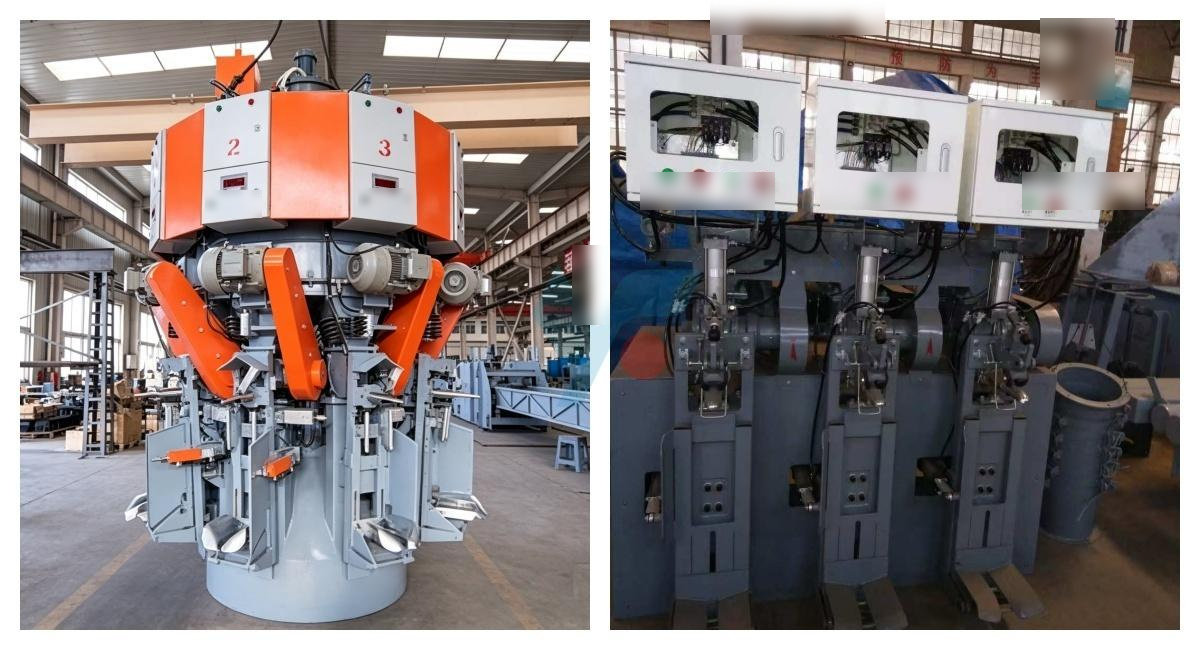
The cement packing machine is designed for automatic filling of cement or mineral powders into bags of a set weight. It is widely used at cement plants, grinding stations and building-materials enterprises.
The equipment usually uses a rotary (impeller) or screw feeder combined with an automatic dosing system, which ensures high speed, stability and accuracy of packing. The machine can operate as part of an automatic line with conveying systems, dust collection and palletizing systems.
Operating principle of the packing machine:
- the material enters the hopper of the packing machine;
- uniform feeding is carried out by means of an impeller or screw;
- the weighing system controls the filling mass;
- when the set weight is reached, feeding stops automatically;
- continuous and efficient packing is ensured.
Advantages of the packing machine:
- High packing speed and productivity
- High dosing accuracy
- High level of automation
- Minimal losses and low level of dust generation
- Reliable and stable operation, easy maintenance
| Parameter | Value |
| Packing type | Valve bags (Valve Bag) |
| Bag weight | 25 kg / 50 kg (adjustable) |
| Throughput | 15–120 t/h |
| Number of spouts | 1 / 2 / 3 / 4 / 6 / 8 / 12 |
| Capacity per spout | 200–300 bags/hour |
| Dosing accuracy | ±0.2–0.5 kg |
| Feed type | Impeller / screw |
| Motor power | 3–11 kW |
| Air pressure | 0.5–0.7 MPa |
| Control system | Automatic / PLC |