

Slag Rotary Dryer
Description:
The fly ash ball mill is important equipment in the fly ash grinding process, designed to process the ash from coal combustion at thermal power plants into building powder with uniform particle size. It is widely used in production sectors such as the cement industry, the manufacture of silicate products, the production of new building materials, refractories, mineral fertilizers, the beneficiation of ferrous and non-ferrous metals, as well as the glass and ceramic industries.
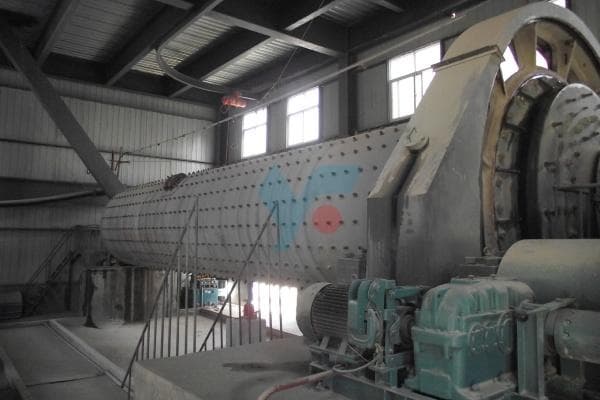
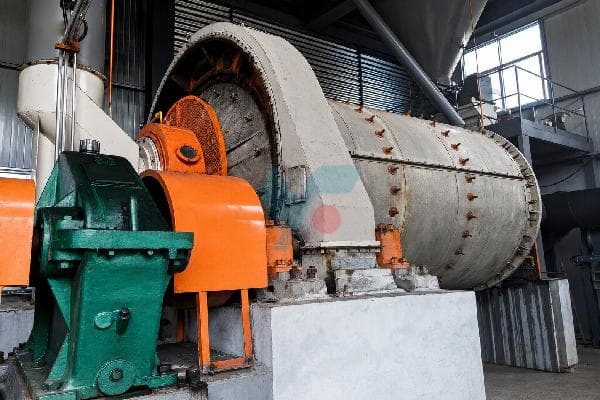
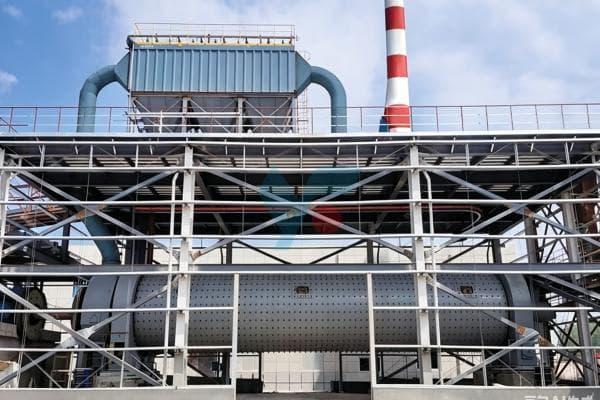
This equipment is a specialized unit optimized for the properties of fly ash on the basis of traditional ball mills. It consists of feeding and discharge sections, a rotating part and a drive mechanism. The working principle lies in crushing the material through the impact and abrasive action of steel balls inside the drum. The equipment is distinguished by stable operation and low energy consumption.
Working principle:
The parameters are selected depending on the particle size of the material to be ground. The material enters the drum through the hollow feeding trunnion. As the mill body rotates, the grinding media, under the action of inertia, centrifugal force and friction, adhere to the liner and are lifted together with the drum. Having reached a certain height, they fall down under their own gravity, crushing the material inside the drum like a projectile.
The material from the feeding device enters the first chamber of the mill evenly through the hollow feeding trunnion. This chamber is fitted with a stepped or wavy liner and contains steel balls of various sizes. The rotation of the body creates centrifugal force, which lifts the balls to a certain height, after which they fall, exerting an impact and abrasive action on the material. After coarse grinding in the first chamber, the material passes through a single-layer partition into the second chamber. This chamber is lined with a flat liner and also contains steel balls for further grinding of the material. The finished powdered product is discharged through the discharge grate, completing the grinding process.
During the rotation of the body, the grinding media also slip, exerting an abrasive action on the material during sliding. To make effective use of this effect when working with coarse-fraction material (for example, when grinding to 20 mesh), the mill body is divided into two sections by means of a partition, forming a two-chamber mill. When entering the first chamber, the material is crushed by steel balls, and when passing into the second chamber it is abraded. The finished ground product is discharged through the hollow trunnion on the discharge side. When grinding material with a fine initial fraction, such as No. 2 sand, granulated slag or coarse fly ash, the partition may be omitted inside the mill body, using a single-chamber variant. In this case, steel cylpebs (steel segments) may also be used as grinding media.
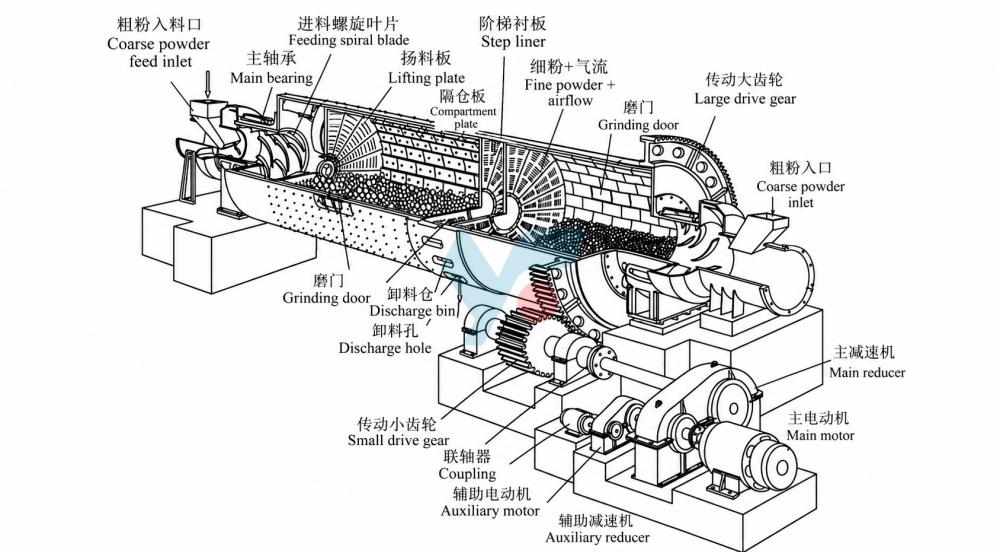
Construction
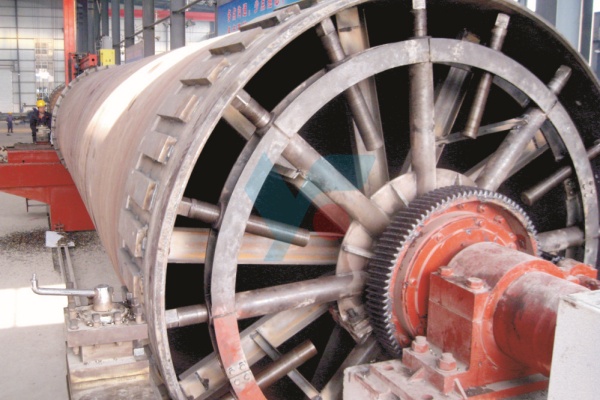
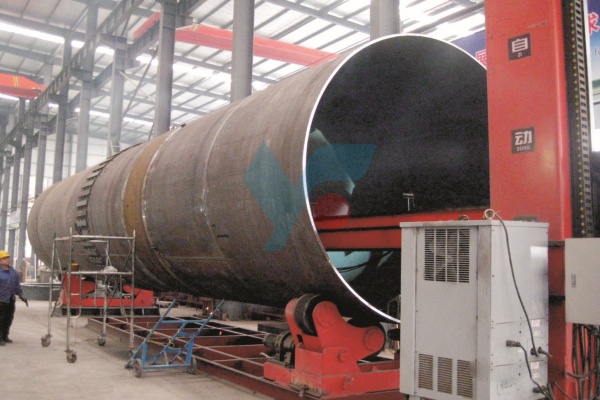
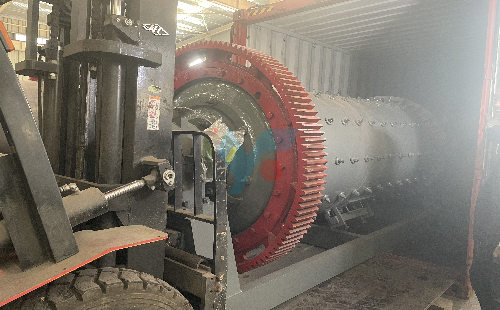
The fly ash ball mill consists of the following main units: the feeding and discharge parts, the rotating mechanism, and the drive system (reducer, small driving pinion, electric motor, electrical control system).
Overall, the equipment includes: the mill body, the feeding and discharge trunnions, the reducer, the coupling, the electric motor, the large and small gears, bearings with housings, and the electrical control system.
Key features of the construction:
- The hollow trunnions are made of cast steel.
- The internal liner is replaceable.
- The large driving gear (girth gear) undergoes machining of the teeth (gear cutting) on cast blanks, which ensures high wear resistance.
- The mill body is lined inside with a wear-resistant liner.
- In addition, some models are provided with a steel frame (base).
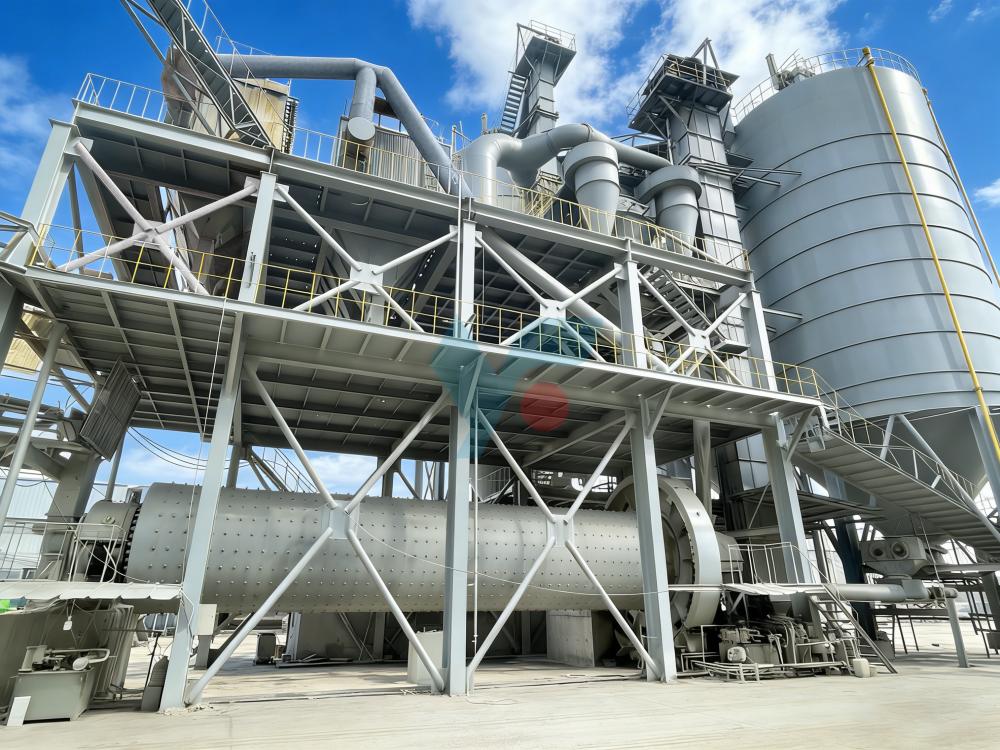
Features and advantages
The fly ash ball mill is specialized equipment developed taking into account the characteristics of fly ash. The equipment has a number of advantages in terms of productivity, grinding efficiency, energy saving, operation, maintenance and environmental friendliness.
The design of the equipment is optimized specifically for processing fly ash, which ensures stable and reliable operation. Special structures, grinding media, as well as wavy liner plates or grooved ring liners are used, which intensify the grinding action and increase grinding efficiency. The fineness of the finished product is uniform, and the output capacity and outlet particle size can be freely adjusted according to user requirements. The equipment is capable of processing raw or coarse ash into ultrafine powder with a certain hydraulic activity for the production of high-quality concrete admixtures, ensuring highly efficient and resource-saving use of fly ash with significant economic benefit.
Thanks to its optimized design, the new generation of equipment uses large double-row self-aligning roller bearings instead of sliding bearings, which simplifies the drive system, speeds up start-up and reduces resistance during operation. Energy consumption is reduced by about 20–30% compared with traditional equipment. The unit is equipped with special electric motors with low starting current and high energy-transmission efficiency. The design of the grooved ring liners not only intensifies the grinding process but also helps to reduce energy costs.
The equipment is usually fitted with an automated centralized PLC control system, which lowers the qualification requirements for operators and reduces the likelihood of malfunctions. The construction is simple and convenient for installation and maintenance. Inspection hatches are provided to facilitate inspection, repair and replacement of the internal wear-resistant elements. Key parts, such as the hollow trunnions, are made of cast steel, the internal liner is replaceable, and the drum is made of wear-resistant steel, which significantly increases the service life of the equipment and reduces maintenance costs. The use of oil-mist lubrication systems provides reliable lubrication of the gear drives and other transmission units, further extending the service life of the equipment.
During operation, the equipment is characterized by a low level of dust and noise, complying with national requirements for green and low-carbon production. The operation of the mill is stable and reliable. If necessary, the equipment can be supplied with a steel support frame, which allows the user to reduce the cost of building a foundation.
Field of application
The fly ash ball mill is important equipment in the process of producing powder from fly ash and is intended for its comprehensive processing and resource utilization. The equipment is widely used in the production of cement, silicate products, new building materials, refractory materials, fertilizers, in ferrous and non-ferrous metallurgy, in ore beneficiation, as well as in the glass and ceramic industries.
This equipment is suitable for processing fly ash, iron ore, copper ore and other materials, supporting both the dry and wet grinding methods.
The main fields of application include thermal power plants, cement plants and other enterprises connected with fly ash processing. After treatment in a ball mill, fly ash can be used as a raw material for the production of cement clinker, the manufacture of sintered brick, autoclaved aerated concrete, foam concrete, as well as in road construction. In addition, useful components such as hollow microspheres and microbeads can be extracted from fly ash.
Moreover, processing fly ash with a ball mill makes it possible not only to achieve the effective use of industrial solid waste, but also to reduce environmental pollution, contributing to the development of a circular economy and environmentally sustainable production.