
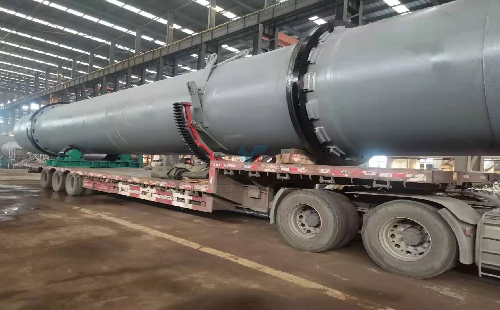
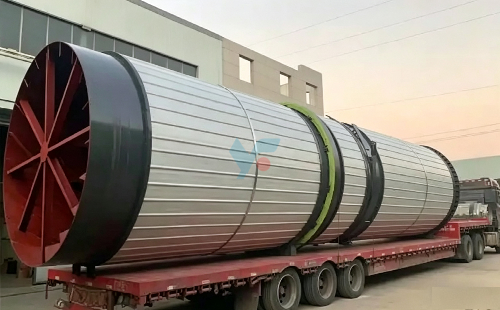
Slag Rotary Dryer
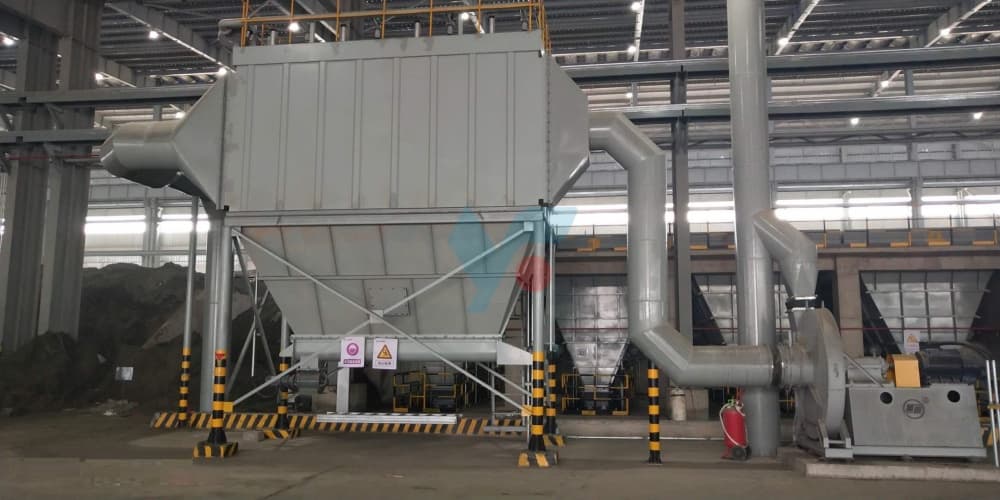
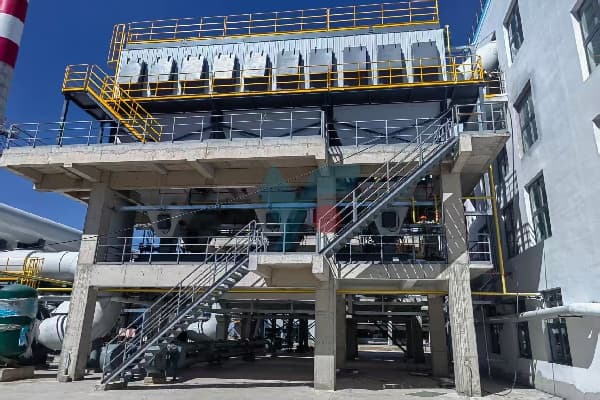
The YQM(M) explosion-proof air-box pulse-jet bag filter is an industrial dust-collection unit that integrates sectional offline cleaning, air-box pulse-jet blowing, high-efficiency filtration and explosion protection. Model range: YQM(M)32–YQM(M)128, with an air-handling capacity of 6900–314000 m³/h.
It is widely used in the following industries:
- cement industry
- coal-powder preparation systems
- mineral-powder processing
- metallurgy
- chemical industry
- grain processing
- woodworking
- combustible and explosive dust conditions
The unit is especially suited to dust-control systems with explosion risk, such as coal mills, coal bunkers and coal-dust conveying.
The unit adopts an air-box pulse-jet cleaning structure, offering strong cleaning capability, low filtration velocity, low operating resistance, high dust-collection efficiency and easy maintenance. The whole machine is equipped with explosion vents, antistatic filter bags, explosion-proof solenoid valves and other safety measures, effectively reducing the risk of dust explosion and ensuring safe and stable system operation.
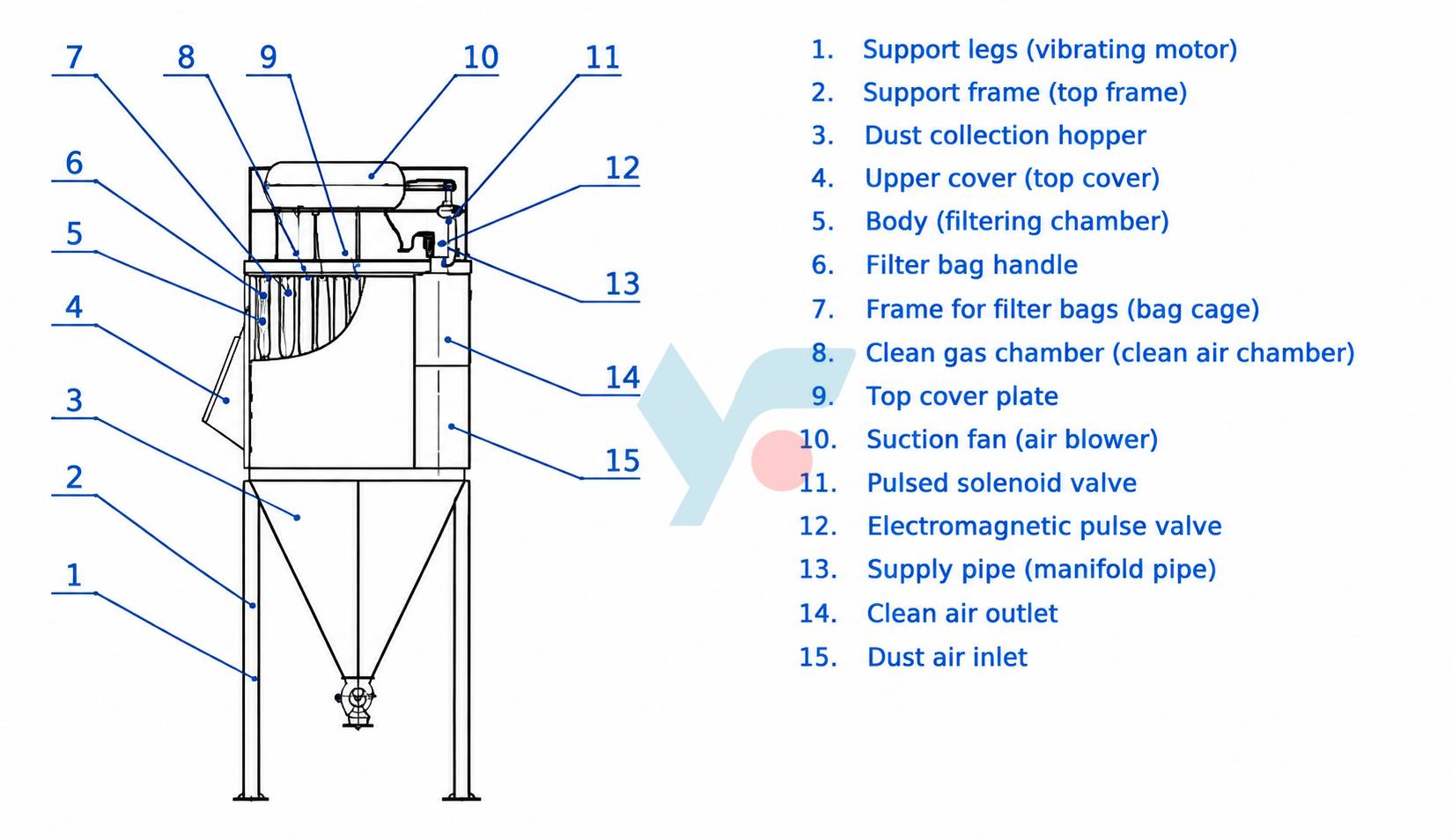
Equipment Structure
The YQM(M)(M) series of air-box pulse-jet explosion-proof bag filters mainly consists of the following parts:
- bottom steel structure
- dust hopper
- upper housing
- housing (chambers)
- inlet and outlet ducts
- filter bags
- cleaning device
- electrical control
In addition, depending on actual conditions, bin-wall vibrators may be fitted on the outer wall of the hopper, and a rotary (star) discharge valve or screw conveyor may be installed at the hopper discharge outlet for dust unloading.
1. Discharge valve 2. Support 3. Dust hopper 4. Explosion vent 5. Housing 6. Filter bag 7. Cage 8. Clean chamber 9. Top cover 10. Air receiver 11. Cylinder lifting valve 12. Solenoid pulse valve 13. Blow pipe 14. Clean-gas outlet 15. Dust-laden gas inlet
Working Principle
1. Filtration Principle
Dust-laden gas enters through the inlet. As it passes through the hopper, some of the coarse dust particles are separated by inertia and gravity and fall directly to the bottom of the hopper. After passing the hopper, the dust-laden gas enters the bag-filtration zone of the middle housing; the gas passes through the filter bags, the dust is retained on the outer surface of the bags, and the cleaned gas enters the upper housing through the bag mouths and is then discharged through the outlet.
2. Cleaning Principle (Pulse Regeneration)
As filtration time increases, the dust layer on the bags keeps thickening and the resistance of the unit keeps rising. When the resistance reaches the set value, the cleaning device starts cleaning. First, the lifting valve of one chamber closes, cutting off the filtering airflow; then the solenoid pulse valve opens, and compressed air expands rapidly in the upper housing in a very short time, rushing into the filter bags, causing the bags to expand, deform and vibrate. Under the scouring of the reverse airflow, the dust adhering to the outer surface of the bags is stripped off and falls into the hopper. After cleaning is complete, the solenoid pulse valve closes, the lifting valve opens, and the chamber returns to the filtration state. The chambers are cleaned in sequence; from the start of cleaning of the first chamber to the start of the next cleaning is one cleaning cycle.
3. Dust Collection
The dust intercepted during filtration and cleaning all falls into the hopper and is then discharged centrally through the hopper outlet.
4. Working Principle of the Explosion-Proof Device
The main pollutant in the mill exhaust gas is extremely fine coal dust. When it meets a spark or the temperature rises to the flash point of the coal-dust/air mixture, a gas explosion may occur. Under normal conditions the explosion vent is held closed by a counterweight, and through the lever principle the valve plate is pressed against the door frame of the vent with a certain force, giving the vent a good air-lock effect during normal operation. When an explosion occurs, the gas pressure inside the filter rises sharply, giving the valve plate an outward thrust; when this thrust moment overcomes the gravity moment of the counterweight, the vent opens and discharges the explosion gas out of the housing, thereby protecting the filter, surrounding facilities and personnel.
Equipment Features
- 1. High dust-collection efficiency — efficiency reaches 99.9% and above, with low emission concentration.
- 2. Offline pulse cleaning — sectional offline cleaning provides thorough cleaning and long bag service life.
- 3. Reliable explosion protection — configurable with:
- explosion relief vent
- antistatic filter bag
- temperature monitoring device
- spark detection system
- Suitable for combustible and explosive dust such as coal powder.
- 4. Low operating resistance — optimized airflow structure reduces system energy consumption.
- 5. Easy maintenance — top bag-changing structure makes servicing quick and convenient.
- 6. High automation — PLC automatic control enables automatic differential-pressure cleaning.
Configuration
Optional filter-bag materials:
- polyester needle felt
- antistatic needle felt
- membrane (PTFE) filter media
- Metamax (meta-aramid)
- PPS high-temperature filter bags
Optional equipment:
- explosion vent
- rotary (star) discharge valve
- screw conveyor
- PLC automatic control system
- differential-pressure detection system
- temperature alarm system
Application Range
- coal-mill system dust collection
- cement-mill tail dust collection
- dryer exhaust-gas dust collection
- mineral-powder production-line dust collection
- lime-powder dust collection
- powder conveying-system dust collection
Installation and Operating Conditions
- Ambient temperature: -20℃ ~ +50℃
- Inlet dust concentration: ≤1000 g/Nm³
- Outlet emission concentration: ≤30 mg/Nm³
- Compressed-air pressure: 0.4~0.6 MPa
- Suitable for continuous operation